Every few months, we get a version of the same call. A purchase manager from a paper mill or a soap unit rings up asking why their alkali cost keeps swinging, and somewhere in the conversation it comes out that nobody at the plant has actually sat down and compared what they’re buying – flakes or lye – against what their process really needs. They’ve just been ordering whatever the previous purchase manager ordered.
That’s not a criticism. Caustic soda Flakes is one of those chemicals everyone assumes they understand because it’s been in use for decades. But the flakes-vs-lye decision has real cost and handling consequences, and it’s worth revisiting even if you’ve been buying the same form for years.
Two Forms, One Chemical
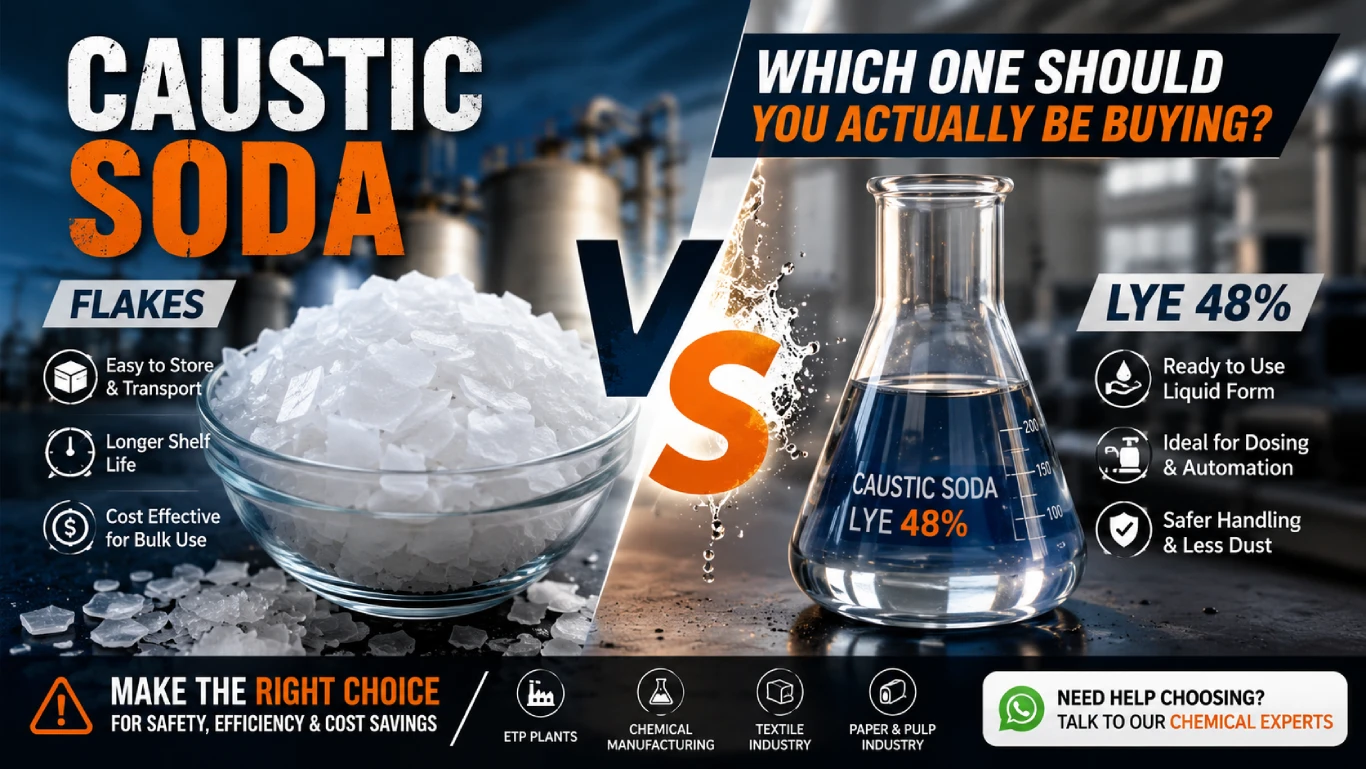
Both Caustic Soda Flakes and Caustic Soda Lye 48% are sodium hydroxide (NaOH) — the difference is water content, not chemistry. Flakes are the dehydrated, solid form, evaporated down to roughly 96-99% purity. Lye 48% is the liquid form straight from membrane-cell electrolysis, standardized to a 48-50% concentration and shipped ready to pump.
Flakes come packed in HDPE-lined bags – 25 kg, 50 kg, or jumbo bags for larger orders – and they keep well if you store them somewhere dry. Lye, on the other hand, moves in tankers or drums and goes straight into your storage tank without any dissolution step on your end. If your plant already handles bulk tanker deliveries of liquid chemicals, lye slots into that infrastructure easily. If you don’t, flakes are often the more practical starting point.
Where the Two Actually Differ
| Parameter | Caustic Soda Flakes | Caustic Soda Lye 48% |
|---|---|---|
| Form | Solid flakes | Liquid solution |
| Concentration | 96–99% NaOH | 48–50% NaOH |
| Needs dilution before use | Yes | No |
| Storage requirement | Dry, sealed, moisture-free | Corrosion-resistant tank (MS/FRP-lined) |
| Shelf life | Long, if kept sealed | Sensitive to temperature swings |
| Transport cost per kg of active NaOH | Lower | Higher (water adds weight) |
| Main handling risk | Dust during dissolution | Splash/contact during transfer |
| Best suited for | Batch-wise, intermittent consumption | Continuous, high-volume consumption |
| Dosing consistency | Depends on how carefully you dilute it | Pre-standardized, easier to automate |
Neither form is objectively “better” – the table above is really a proxy for one question : how much caustic soda do you go through in a month, and do you have the tank infrastructure to handle it as a liquid?
What Different Industries Are Actually Doing
Paper and pulp mills running continuous bleaching lines tend to gravitate toward lye 48%, mainly because it plugs into automated dosing without a dissolution stage in between. Fewer manual steps means fewer places for concentration to drift mid-shift, which matters when you’re chasing a brightness spec.
Textile units are more split. A smaller dye house doing batch work might find flakes easier to store between runs, while a larger composite mill running dyeing and mercerizing continuously usually settles on lye for the same reason paper mills do.
Soap and detergent manufacturers working through traditional saponification still lean heavily on flakes, because the process wants a controlled, precise dissolution at a known concentration – easier to manage when you’re starting from a solid.
Water treatment plants doing pH correction almost always prefer lye, since it goes straight into a metering pump without anyone needing to dissolve flakes on site. We’ve covered dosing logic for a related coagulant in our piece on how ferric chloride works in ETP systems — a lot of the same “less manual handling, more consistency” logic applies here.
Dairy and food processing units running CIP cleaning cycles usually go with lye for the automation benefit, though smaller operations sometimes stick with flakes purely to manage cash flow on smaller orders.
The Price-Per-Kg Trap
Here’s where most buyers lose money without realizing it. Someone compares the rate per kg of flakes against the rate per kg of lye and picks whichever number looks smaller. That comparison is meaningless, because lye is roughly half water by weight — you need close to double the tonnage of lye to deliver the same amount of active NaOH that flakes would give you.
The number that actually matters is :
Price per kg ÷ NaOH concentration (%) = true cost per kg of active alkali
Run both options through that formula before you commit. For high-volume buyers with tanker infrastructure already in place, lye often still comes out ahead once you factor in labour, dust losses, and dissolution time saved — but you won’t know until you do the math on your own numbers.
Storing and Handling Both Safely
Flakes need a dry warehouse, away from moisture, with bags kept sealed until they’re actually used – once air gets in, they clump and start absorbing CO₂ from the atmosphere, which affects purity over time. Anyone handling the dissolution step should be in gloves, goggles, and a dust mask, since the exothermic reaction with water can get surprisingly hot.
Lye needs a proper corrosion-resistant tank – mild steel with rubber lining or FRP — kept away from temperature extremes. Very cold conditions can cause it to crystallize, which is a hassle to deal with once it happens. Bunded storage and proper venting are non-negotiable here, same as with any of the acids and alkalis we supply in bulk.
Sourcing From Ankleshwar
We supply both Caustic Soda Flakes and Caustic Soda Lye 48% out of our facility in GIDC Ankleshwar – one of the more established chemical manufacturing belts in the country, which helps on both pricing and dispatch turnaround. A few things that tend to matter to the buyers we work with:
Both forms are available from the same supplier, so if your consumption pattern shifts seasonally, you’re not stuck switching vendors.
Lye moves out by tanker with a 24–48 hour dispatch window, direct to your plant or ETP. MSDS is provided on request for every batch, and we’re GST-registered and MSME-certified, which usually simplifies things on the compliance side for larger buyers.
You can read more about how we operate on our About Us page, or browse the rest of our product range — including ferric chloride, acids, and other alkalis — if caustic soda isn’t the only thing you’re sourcing.
A Few Questions We Get Often
Can we switch from flakes to lye without overhauling our setup?
Usually yes, but budget for storage tanks and metering pumps if you don’t already have liquid-handling infrastructure. The switch tends to pay for itself only once your consumption volume is high enough to justify it.
Which one lasts longer in storage?
Flakes, generally – they’re less affected by temperature swings than the liquid form, as long as moisture stays out.
Is lye riskier to transport than flakes?
Both are corrosive and need careful handling, but lye needs tanker-based bulk transport with spill containment measures. Flakes travel in sealed bags with a lower spill risk, though dust exposure is its own concern during handling.
What concentration is your lye supplied at?
48–50%, kept consistent batch to batch so your dosing calculations don’t need adjusting every time a new load arrives.
Do you supply both in bulk?
Yes – flakes in jumbo bags, lye by tanker (25–30 KL per load).
Still Deciding Which One Fits?
If you’re not sure which form suits your process, send us your monthly consumption volume and current storage setup — our team can walk you through the actual numbers rather than a generic recommendation. For anyone already dealing with us on ferric chloride or another product, feel free to bundle the query; we handle both under one roof, as covered on our products page.