Copper doesn’t come off a circuit board by itself. Somewhere between your design file and a finished PCB, a chemical has to eat away every trace of unwanted copper – cleanly, evenly, and on schedule. That chemical, nine times out of ten, is Ferric Chloride.
If you’re sourcing it for a PCB manufacturing line, you’ve already hit the first real decision: anhydrous powder or ready-mixed liquid solution? It sounds like a small choice.
It isn’t. Get it wrong and you’re looking at inconsistent etch rates, wasted drums, or a solution that’s too weak to clear copper on the first pass.
This guide breaks down both forms – what they are, how they behave on the line, and which one actually makes sense for your volume and setup.
What Ferric Chloride Actually Does During Etching
Ferric Chloride (FeCl₃, CAS 7705-08-0) etches copper through a straightforward redox reaction: the Fe³⁺ ions oxidise the exposed copper, pulling it off the board as copper chloride while the ferric chloride itself reduces to ferrous chloride. Whatever copper isn’t protected by the resist mask disappears; the traces underneath stay intact.
The reaction only works well within a narrow band of concentration and temperature. Too dilute, and etching drags on, undercutting fine traces. Too strong or too hot, and you risk uneven attack on the copper. This is exactly why the anhydrous-vs-liquid decision matters more than it looks – it’s really a decision about how much control you want over that concentration.
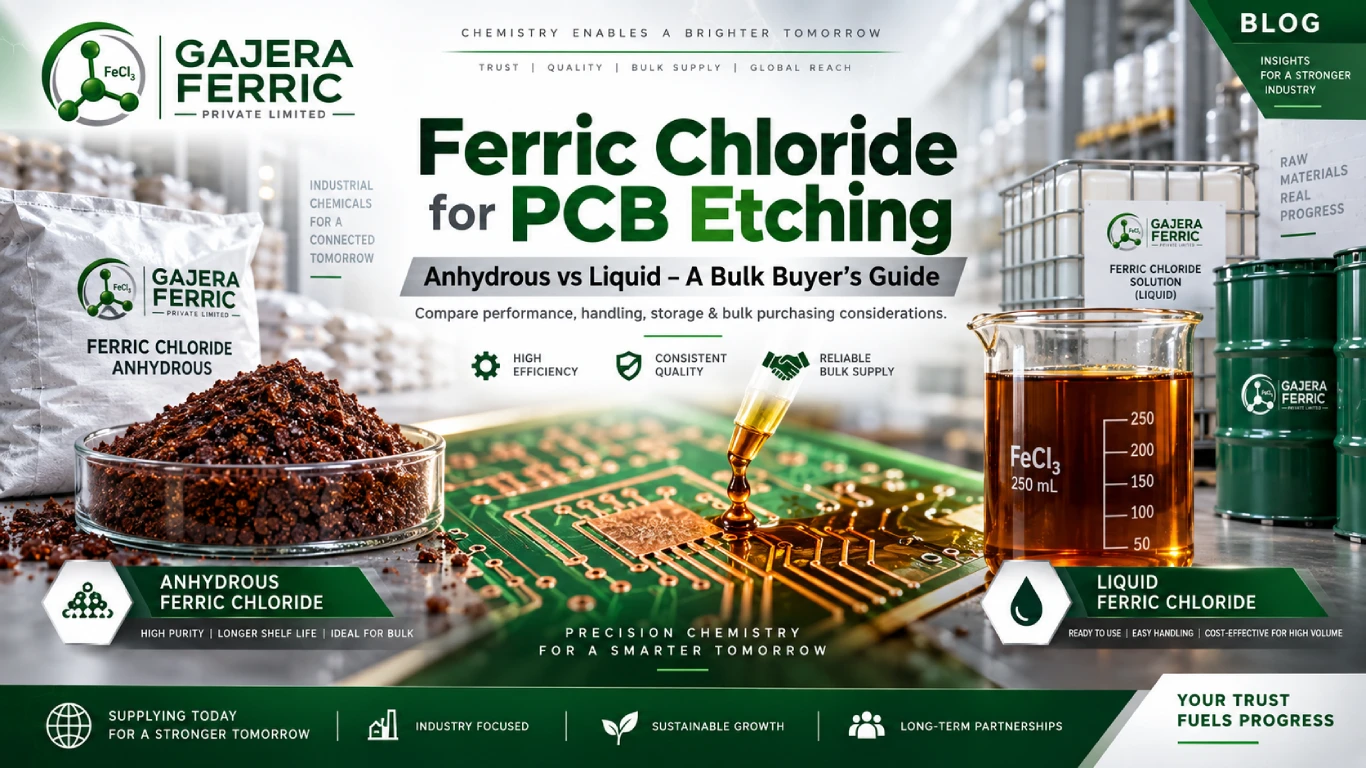
Anhydrous Ferric Chloride Powder Form
Anhydrous FeCl₃ is a dark, crystalline solid, typically supplied at 96–98%+ purity. Nothing is added – you’re buying the compound itself, and you build the etching bath from there.
Why buyers choose it:
- Freight efficiency. You’re not paying to ship water. For units importing or moving material across states, this cuts transport cost per kilogram of active FeCl₃ meaningfully.
- Longer, more stable shelf life when stored correctly, since there’s no water content to separate or evaporate.
- Full control over bath strength. You mix to the exact concentration your etch line calls for, rather than inheriting a fixed dilution.
What it demands in return:
- It’s strongly hygroscopic – leave the container open in Ankleswar’s humidity for even a short while and it starts pulling moisture from the air, clumping and losing consistency.
- Dissolving it is an exothermic reaction. Water always goes in slowly, with the powder added gradually – never the reverse – and with proper ventilation and PPE.
- You need a trained operator and a documented mixing SOP. Get the ratio wrong and the whole batch is off-spec.
Liquid Ferric Chloride Solution: Ready to Use
Liquid FeCl₃ – usually supplied around 40–42% concentration — is pre-dissolved and ready to dose straight into the etching bath.
Why buyers choose it:
- Zero mixing risk. No exothermic dissolution step on your floor, no operator error in dilution.
- Faster line changeovers. Pour, dose, etch – useful for job-shop PCB units running mixed volumes.
- Simpler safety protocol, since there’s no powder-handling or dust-inhalation exposure to manage.
What it demands in return:
- You’re shipping water along with the active chemical, which pushes up per-kg landed cost for anything moving long distances.
- Slightly shorter practical shelf life, and it needs to be stored in corrosion-resistant containers, away from temperature extremes.
- Fixed concentration – if your process needs a non-standard strength, you’re diluting or fortifying a pre-set solution rather than building from scratch.
Anhydrous vs Liquid: Side-by-Side
| Factor | Anhydrous Ferric Chloride | Liquid Ferric Chloride (40–42%) |
|---|---|---|
| Form | Crystalline powder, 96–98%+ purity | Pre-dissolved solution |
| Freight cost per kg FeCl₃ | Lower (no water weight) | Higher (water included) |
| On-site handling | Requires trained mixing, PPE, ventilation | Pour-and-dose, minimal prep |
| Concentration control | Fully customisable | Fixed at supplied strength |
| Shelf life | Longer if kept moisture-free | Moderate, needs stable storage |
| Best suited for | High-volume, dedicated etch lines with SOPs in place | Job-shop / mixed-volume units, faster setup |
So Which One Should You Actually Order?
If your plant runs a dedicated, high-throughput etching line and you already have a mixing SOP and trained handling staff, anhydrous usually wins on landed cost – especially once you’re ordering by the tone.
If you’re a smaller PCB unit, running variable volumes, or you simply don’t want a mixing step introduced into your floor process, liquid solution removes that friction entirely.
Either way, consistency matters more than the form itself. A batch that’s off by even a couple of percentage points in purity changes your etch rate and, downstream, your rejection numbers. That’s worth checking with whoever you’re sourcing from before the tanker or drum ever leaves the plant – ask for the current MSDS and batch specification rather than assuming last order’s numbers still hold.
Storage, Handling, and Disposal Notes
- Store anhydrous powder in sealed, moisture-proof packaging, in a cool, dry, well-ventilated area — never near alkalis or reactive metals.
- Store liquid solution in corrosion-resistant (typically HDPE-lined) containers, away from direct sunlight and freezing conditions.
- Both forms are classified as corrosive (UN 1773). Gloves, goggles, and protective clothing aren’t optional on the mixing or dosing station.
- Spent etchant contains dissolved copper and shouldn’t go down the drain. Regeneration or licensed disposal, in line with your state pollution control board’s norms, is the only compliant route — and it’s also the route that gets more etching life out of every litre you’ve bought. Industry data on photochemical machining lines backs this up directly plants that regenerated their etchant used it dramatically more efficiently than those that didn’t, with the gap between the best- and worst-performing companies running into multiples.
Sourcing Ferric Chloride for PCB Manufacturing in India
Ankleshwar GIDC sits inside one of India’s largest chemical manufacturing hubs, which is exactly why a lot of bulk FeCl₃ for both water treatment and electronics use moves out of this belt. For a PCB manufacturer, that proximity translates into shorter dispatch windows and fewer handling losses versus sourcing from further afield.
Gajera Ferric Private Limited supplies both Ferric Chloride Anhydrous (98%+ purity) and Ferric Chloride Solution (42%) out of its Ankleshwar facility, with MSDS provided on request and batch-to-batch consistency tracked for every dispatch — the two things that actually matter once you’re running a production line, not a one-off experiment. Bulk tanker delivery is available for liquid grade, and export documentation support is in place for international PCB manufacturers sourcing from India.
If you’re setting up a new etch line or reviewing your current supplier, it’s worth comparing both product grades against your actual throughput and handling capacity before locking in a purchase order.
Frequently Asked Questions
1. Can I switch from liquid to anhydrous Ferric Chloride without changing my etching process?
Yes, as long as you replicate the same working concentration. The etching chemistry is identical – the difference is entirely in how you arrive at that concentration, not in how it etches copper.
2. How long does Ferric Chloride solution stay usable for etching?
A working bath can be reused multiple times as it gradually weakens with each etch cycle. Most units track this by etch rate or by dipping test coupons, replacing or regenerating the bath once etch time stretches noticeably beyond baseline.
3. Is anhydrous Ferric Chloride more dangerous to handle than the liquid form?
It carries different risks rather than strictly greater ones – dust inhalation and an exothermic mixing reaction versus splash/contact risk with the pre-mixed liquid. Both need PPE and a documented handling procedure.
4. What purity should I ask for when ordering anhydrous Ferric Chloride for PCB etching?
96% or higher is the standard for consistent electronics-grade etching. Always ask for the batch-specific assay, not just a nominal spec sheet figure.
5. Does Ferric Chloride etchant need to be disposed of separately from regular industrial wastewater?
Yes. Spent etchant carries dissolved copper and must go through regeneration or licensed hazardous-waste disposal in line with your state pollution control board’s requirements – not general effluent discharge.
6. Can Ferric Chloride Anhydrous also be used for water treatment, or is it etching-only?
The anhydrous form is occasionally used in specialized dosing setups, but liquid Ferric Chloride (40–42%) is the standard for water and wastewater coagulation – it’s what most municipal and industrial ETP systems are actually designed to dose.