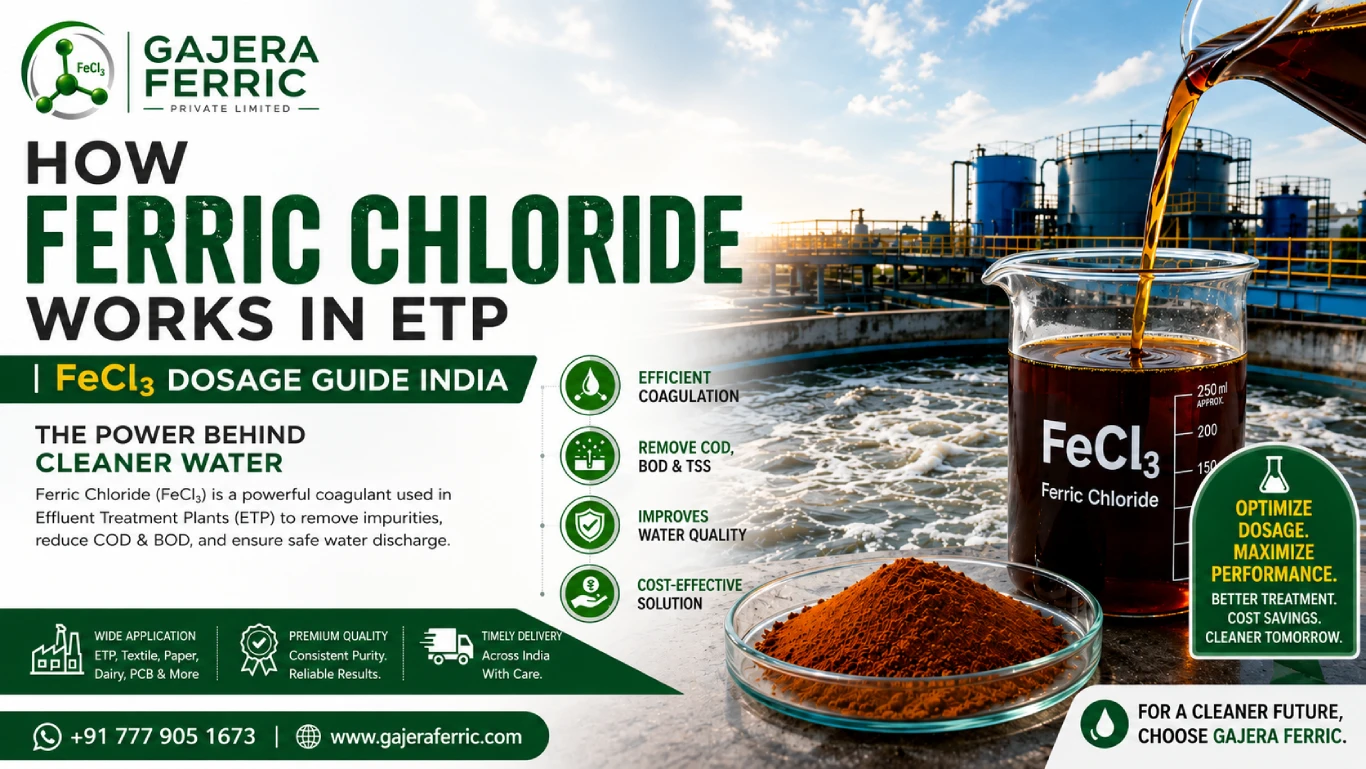
Effluent from industrial activities contains a variety of solid and liquid pollutants that cannot be removed simply by leaving the wastewater to stand.
Some of these impurities include suspended solids, colloidal particles, phosphorus, heavy metals, oils, grease, and dissolved organic contaminants. To address these, ferric chloride has long been a top choice among the chemical coagulants used in ETPs throughout India.
If you go to textile processing plants in Gujarat, one can find that dairy industries in Maharashtra, pharmaceutical manufacturers, paper mills, leather processing units and chemical industries are also reliant on Ferric Chloride (FeCl₃) to enhance the water clarity, reduce the sludge volume, and meet CPCB and SPCB discharge norms.
Thanks to the outstanding coagulation property of ferric chloride, the wide pH level at which it works and the fact that it also removes phosphorus and heavy metals, it is one of the favorite chemicals for wastewater treatment in up-to-date Effluent Treatment Plants (ETPs).
Mainly, factories from industries of diverse areas in India and world markets are supplied by us at Gajera Ferric Private Limited located in GIDC Ankleshwar, Gujarat with excellent quality Ferric Chloride solutions. Besides that, our technical team is also available for customers to help them in FeCl₃ dose calculation to get the highest treatment efficiency and reduce cost.
By going through this guide, you will get to know :
- What is Ferric Chloride and what is its purpose in ETPs
- The coagulation chemical reaction
- FeCl₃ dosage for different industries
- The dosing methods and procedures
- How does it stack up to other coagulants?
- How to pick the best Ferric Chloride seller in India
What Is an Effluent Treatment Plant (ETP)?
An Industry-specific wastewater purification system known as an Effluent Treatment Plant (ETP) is equipped with thenecessary capacity to neutralize physical, chemical, and biological impurities present in industrial wastewater before disposing it or reusing it.
Unlike community sewage treatment plants, industrial ETPs have to deal with very diverse types of wastewater depending on the production process.
The pollutants in question are :
- Total Suspended Solids (TSS)
- Chemical Oxygen Demand (COD)
- Biological Oxygen Demand (BOD)
- Color
- Heavy Metals
- Oils & Grease
- Phosphates
- Toxic Organic Compounds
In general, ETPs consist of a sequence of sections :
Primary Treatment
Extraction of big particles, sand, floating oils, and equalization.
Chemical Treatment
The usage of coagulant substances like Ferric Chloride to reverse the charge of suspended particles.
Flocculation
Growth of bigger flocs using polymers.
Secondary Treatment
Biological breakdown of the dissolved organic matter.
Tertiary Treatment
Filtration, polishing as well as disinfecting or advanced treatments for reuse.
Among these, the chemical coagulation phase is usually considered the most crucial for the fast removal of contaminants.
Why Ferric Chloride Is Used in ETP
Ferric Chloride (FeCl₃), a chemical used in water purification, is a type of iron-based metal salt that helps in removing the negative charges of the suspended particles in a very short time.
Since these particles, by their nature, repel each other, sedimentation is not possible.
On addition of Ferric Chloride, a series of events starts happening in the wastewater :
- The charges get neutralized instantaneously.
- The very small particles crash and stick together.
- The big clumps get formed very quickly.
- The clumps settle down rapidly in the clarifiers.
- The water is visibly clearer.
Besides this major benefits that you can get by using FeCl₃ include :
- Greatly reduces turbidity
- Efficient removal of suspended solids
- Highly effective phosphorus precipitation
- Removal of toxic heavy metals
- Improvement in sludge dewatering
- Lowered sludge handling costs
- Consistent performance even with changes in wastewater properties
Due to the above reasons, FeCl₃ is considered among the best coagulants and it is the most widely used one in the Indian wastewater treatment sector.
Coagulation Chemistry – How Ferric Chloride Works
Knowing the chemical properties of Ferric Chloride is useful in helping workers figure out the right amount for adding and enhancing the result of the treatment.
The process that happens when Ferric Chloride is mixed with water :
FeCl₃ + 3H₂O → Fe(OH)₃ + 3HCl
The ferric hydroxide is the product of this process and it is gelatinous precipitate with a very large surface area.
Besides this precipitate :
- It adsorbs the suspended solids
- It captures the colloidal particles
- It traps the oils
- It removes the color compounds
- It binds the phosphorus
- It absorbs the heavy metals
The flocs created this way become dense enough to be dropped down by gravity in the clarifiers.
The main things that affect how well coagulation works are :
- The pH level
- The temperature
- The characteristics of the wastewater
- The intensity of mixing
- The retention time
- The concentration of Ferric Chloride
In the case of industrial wastewater, the pH range for the best result is usually between 5.5 and 8.5, but the exact ones depend on the application.
Step-by-Step FeCl₃ Dosing Process in an ETP
Correct dosing is one of the key factors in fully exploiting the treatment method while limiting the use of chemicals.
Step 1: Wastewater Analysis
Test your wastewater for :
- pH
- COD
- BOD
- TSS
- Turbidity
- Phosphates
- Heavy metals
Step 2: Conduct a Jar Test
Such workbench testing in a lab can help come up with the best Ferric Chloride dose prior to full-scale application.
Step 3: Prepare the Dosing Solution
Your chemical supplier is your best guide for the concentration of the raw material to be used. Also, if the conditions are right in terms of dilution and mixing steps, make sure to do these correctly.
Step 4: Rapid Mixing
Introduce Ferric Chloride through the flash mixer to obtain a very fine, homogenous distribution of the chemical throughout the wastewater.
Step 5: Flocculation
If you plan to use a polymer, it will be a good idea to add it at this stage to help make the flocs bigger and better at settling.
Step 6: Sedimentation
The settled flocs in the clarifier separate the contaminants from the treated water.
Step 7: Performance Monitoring
Follow up on :
- Turbidity
- TSS
- COD
- Sludge volume
- Residual iron
- pH
By regularly checking these parameters, you will be able to lower the amount of chemicals used and still have effective treatment results.
Recommended Ferric Chloride Dosage by Industry
The ideal FeCl₃ dosage depends on wastewater characteristics and should always be confirmed through laboratory jar testing.
| Industry | Typical FeCl₃ Dosage (mg/L) | Main Treatment Objective |
|---|---|---|
| Textile | 60–180 | Color removal, suspended solids reduction |
| Dairy | 40–120 | Fat, protein, COD removal |
| Pharmaceutical | 100–250 | Complex organics and color removal |
| Paper & Pulp | 80–200 | Fiber recovery, turbidity reduction |
| Tannery | 120–300 | Chromium, sulfides, suspended solids removal |
Important : These dosing ranges are only approximate. The exact quantity required depends on the quality of the influent, pH, and your treatment objectives. It is essential to conduct jar testing prior to full-scale dosing implementation.
Request a Free Dosage Consultation
It is important to note that the dosage ranges given above are mainly for guidance. The actual quantities needed will be influenced by factors such as the quality of the influent, pH and treatment objectives. Jar testing must always be done as part of the prep for full-scale dosing.
Choosing the most appropriate Ferric Chloride dosage can go a long way in enhancing the performance of the treatment process as well as lowering the costs of operating.
The experts at Gajera Ferric Private Limited are always ready to help you with advising on the right product for your needs, its use, and dosage optimization in ETPs of various sectors, viz., textile, dairy, paper, pharmaceutical, leather, and other industries.
To share your wastewater treatment needs, reach us at :
Before & After Treatment Performance Using Ferric Chloride in ETP
One of the main reasons why industries prefer ferric chloride in their Effluent Treatment Plants (ETP) is for its capacity to considerably enhance the quality of wastewater in a very short time.
After the proper FeCl₃ concentration is found by jar testing and the chemical is added under controlled conditions, it can very effectively upheave suspended particles and make them settle quickly.
In fact , treatment levels depend on the nature of the & wastewater , pH, and other parameters, however, several industries report major decreases in turbidity, Total Suspended Solids (TSS), Chemical Oxygen Demand (COD), color, phosphorus, and some heavy metals.
Typical Performance Improvement
| Parameter | Untreated Wastewater | After FeCl₃ Treatment* | Typical Reduction |
|---|---|---|---|
| Turbidity | 400–1200 NTU | 20–80 NTU | 80–98% |
| TSS | 800–3000 mg/L | 40–250 mg/L | 85–98% |
| COD | 1500–6000 mg/L | 600–2500 mg/L | 30–70% |
| Color | Very High | Low | Up to 95% |
| Phosphorus | 10–60 mg/L | <2 mg/L | 70–95% |
| Heavy Metals | Variable | Significantly Reduced | 60–95% |
Wastewater characteristics, pH, hydraulic retention time, polymer selection, and correct dosing are performance attributes.
Advantages of Optimized Ferric Chloride Dosing
Properly optimized FeCl₃ dosing schedules enjoy the following operational and economic benefits :
- Accelerated floc formation
- More effective sludge settling
- Significantly decreased clarifier overflow
- Markedly lowered turbidity of treated water
- Enhanced conformity with pollution control standards
- Diminished polymer consumption
- More efficient sludge dewatering
- Substantially reduced operating costs overall
Industries that want to reuse their treated water or discharge within stringent regulatory limits can achieve great performance in their ETP by ferric chloride dosage optimization.
Ferric Chloride vs. Other Common Coagulants
Selecting the right coagulant is essential for achieving efficient wastewater treatment. While Alum and Poly Aluminium Chloride (PAC) are also widely used, Ferric Chloride is often preferred for demanding industrial applications due to its higher coagulation strength and broader contaminant removal capabilities.
Comparison Table
| Parameter | Ferric Chloride (FeCl₃) | Alum | PAC |
| Coagulation Efficiency | Excellent | Good | Very Good |
| Phosphorus Removal | Excellent | Moderate | Good |
| Heavy Metal Removal | Excellent | Limited | Moderate |
| High COD Wastewater | Excellent | Moderate | Good |
| Colour Removal | Excellent | Good | Very Good |
| Performance in Wide pH Range | Excellent | Moderate | Good |
| Sludge Dewatering | Excellent | Moderate | Good |
| Industrial ETP Suitability | Excellent | Moderate | Very Good |
Why Industries Prefer Ferric Chloride
Ferric chloride is a popular choice for industrial wastewater treatment plants (ETPs) because it :
- Creates dense and quickly settling flocs
- Is still very functional with highly polluted wastewater
- Works great in removing phosphorus
- Clarifies water more water efficiently
- Is fast at reducing suspended solids
- Has a great track record with industries such as textile, paper, pharmaceutical, dairy, tannery, PCB, and chemical
For municipal uses , alum may still be the most economical choice and PAC may be superior for potable water treatment. However, ferric chloride can give you a much better solution in heavily polluted industrial wastewater.
Choosing the Right Ferric Chloride Supplier in India
The level of success in wastewater treatment is not just related to dosing but also depends on the quality and uniformity of the Ferric Chloride delivered.
When choosing a supplier, you should take into account :
Product Quality
You need to make sure that the Ferric Chloride is compliant with industrial specifications in terms of concentration and with only trace amounts of impurities.
Manufacturing Expertise
It’s better to deal with manufacturers who have a history of supplying industrial ETPs and WTPs.
Technical Support
Whether jar testing, dosage optimization, product selection or other aspects, a supplier should be able to guide you through :
- Jar testing guidance
- Dosage optimization
- Storage recommendations
- Safety handling practices
- Product selection
Packaging Options
If required, samples of each packaging item may be made available for inspection. Stock and consignments may include, but not limited to :
- 50 kg Carboys
- 200 L HDPE Drums
- 1000 L IBC Tanks
- Bulk Tanker Supply
Reliable Logistics
Having delivery on time are essential steps to ensuring operations do not get disrupted and wastewater treatment continues without interruptions.
Why Choose Gajera Ferric Private Limited?
Gajera Ferric Private Limited is a reliable manufacturer and supplier of Ferric Chloride based in GIDC Ankleshwar, Bharuch, Gujarat.
The company deals in premium quality Ferric Chloride which is used by the following industries :
- Effluent Treatment Plants (ETP)
- Water Treatment Plants (WTP)
- Textile Processing
- Paper Mills
- Dairy Processing
- Pharmaceutical Manufacturing
- PCB Manufacturing
- Leather Processing
- Chemical Industries
- Export Markets
Committed heavily towards quality, expertise, and timely delivery, Gajera Ferric is helping its customers all over India with their wastewater treatment requirements.
FAQ’s
1. What is the ideal Ferric Chloride dosage in an ETP?
The correct dosing depends on wastewater parameters, such as turbidity, COD, TSS, pH, levels of phosphorus, and heavy metals. In general, industrial doses are between 40 and 300 mg/L, but performing jar tests is the only way to figure out the perfect dosage.
2. How does Ferric Chloride remove suspended solids?
The way in which Ferric Chloride removes the suspended solids is that it cancels out the charges on the surfaces of the particles so that the particles can get together and form bigger flocs which the clarifier will let fall down quickly.
3. Can Ferric Chloride reduce COD?
It can. Ferric Chloride is a good treatment option to remove the organic fraction in the suspended and colloidal phase, and, in most cases, it can lead to a COD reduction of 30-70% depending on the characteristics of the wastewater and conditions of the treatment.
4. Is Ferric Chloride better than Alum?
For industrial wastewater, Ferric Chloride, compared to Alum, can deliver better results with respect to phosphorus removal, heavy metal removal, reduction of color, and sludge settling.
5. Which industries commonly use Ferric Chloride?
Ferric Chloride finds its greatest usage in the following :
- Textile Industry
- Dairy Processing
- Pharmaceutical Manufacturing
- Paper & Pulp Mills
- Tanneries
- PCB Manufacturing
- Municipal Water Treatment
- Chemical Industries
6. How can I determine the correct FeCl₃ dosage?
The best way of deciding this is to make a jar test in the laboratory with water samples that you bring from the real wastewater. This will not only allow you to find the right dosage but at the same time, you will be minimizing the chemicals’ consumption and maximizing the efficiency of the treatment.
Request a Free Dosage Consultation from Gajera Ferric
Every wastewater stream is unique. Underestimating dosage of Ferric Chloride may be a mistake that results in insufficient coagulation, while overdosing leads to increased costs and sludge production.
Experts at Gajera Ferric Private Limited are ready to assess your wastewater profile and suggest suitable Ferric Chloride dosing that will ensure you get most of the treatment process.
Operating a textile processing unit, dairy plant, pharmaceutical facility, paper mill, tannery or chemical manufacturing plant doesn’t matter our specialists can help you pick the right Ferric Chloride solution for your ETP.
Contact Gajera Ferric Private Limited
Want to find a trusted Ferric Chloride supplier in India?
Gajera Ferric Private Limited offers great quality Ferric Chloride from its manufacturing plant located in GIDC Ankleshwar, Bharuch, Gujarat and provides services to customers throughout India and export markets.
Contact our technical team immediately for :
- Datasheets
- Price quotations for bulk orders
- Technical support
- Simplified jar test procedures
- Different packaging options
- Prompt delivery across India
Walk in :
Summary
Among several reputed coagulants for Effluent Treatment Plants vis-à-vis modern technologies, Ferric Chloride is one of the options that make it fairly dependable and effective. It facilitates the removal of suspended solids, phosphorus, color, heavy metals along with organic contaminants that makes its use, a preferred choice among industries like textiles, pharmaceuticals, dairies, paper mills, tanneries, and chemicals.
Treatment of wastewater is an art that depends on many other factors besides just the addition of chemicals. Jar testing, proper dosage of FeCl₃, control of pH, competent supplier label contribute to consistent treatment performance meeting the required standards.
Working with Gajera Ferric Private Limited not only gives industries a supply of high quality Ferric Chloride but also the fan out of expert technical support, dependable logistics, and customized dosing guidance.
Thinking of upgrading ETP efficiency, lowering treatment costs, and meeting environmental compliance? Get in touch with our team now through :
Want Bulk Supply of Ferric Chloride for Your Project?
Managing an industrial ETP or a municipal plant, working on an infrastructure project or large-scale wastewater operation, having a local manufacturer as your partner can really give you a boost in treatment efficiency and also in cost reduction of operation.
Your Queries :
Get in touch with a coated factory delivering ferric chloride in GIDC Ankleshwar & arrange continuous supply chain to your 2026 projects.
How we can support your water treatment and industrial chemical requirements.
- +91 9601061983
- +91 8401457622
- info.gajeraferric@gmail.com
- Plot No. 5904, Sajjan India Road, Ankleshwar GIDC, Ankleshwar, Gujarat 393010